The Goings On – February 2025 (Almost Caught Up!)

A bouncy song and dance we do each year with the 28 days of February. A well choreographed routine of lifts, twists with fancy footwork. The waltz of seasonal change ensues. However, who is leading who?

A Month To Catch Up

With all the planting done in January, it may seem safe to assume that planting was caught up, if not ahead! However, this was not the case. Among other items, onions managed to fall through the cracks of our planting schedule. They were on the schedule, however, we ordered them later than we usually do. When they arrived we were slightly prepared to plant about a ¼ of them. That’s still quite a few onions that needed a home. Thankfully we were able to find that home over the weeks that unfolded during the month.

One thing we have absolutely learned over the years is that interplanting onions and garlic with green leafy veggies is a natural layer of protection. The key is to plant the greens after the garlic and onions are well established. With onion plants it is not so much an issue as the plants are pretty well established. This year we interplanted onions with our Chinese cabbage varieties. In the past, the pest pressure was rough! This will hopefully yield a more pleasant result.

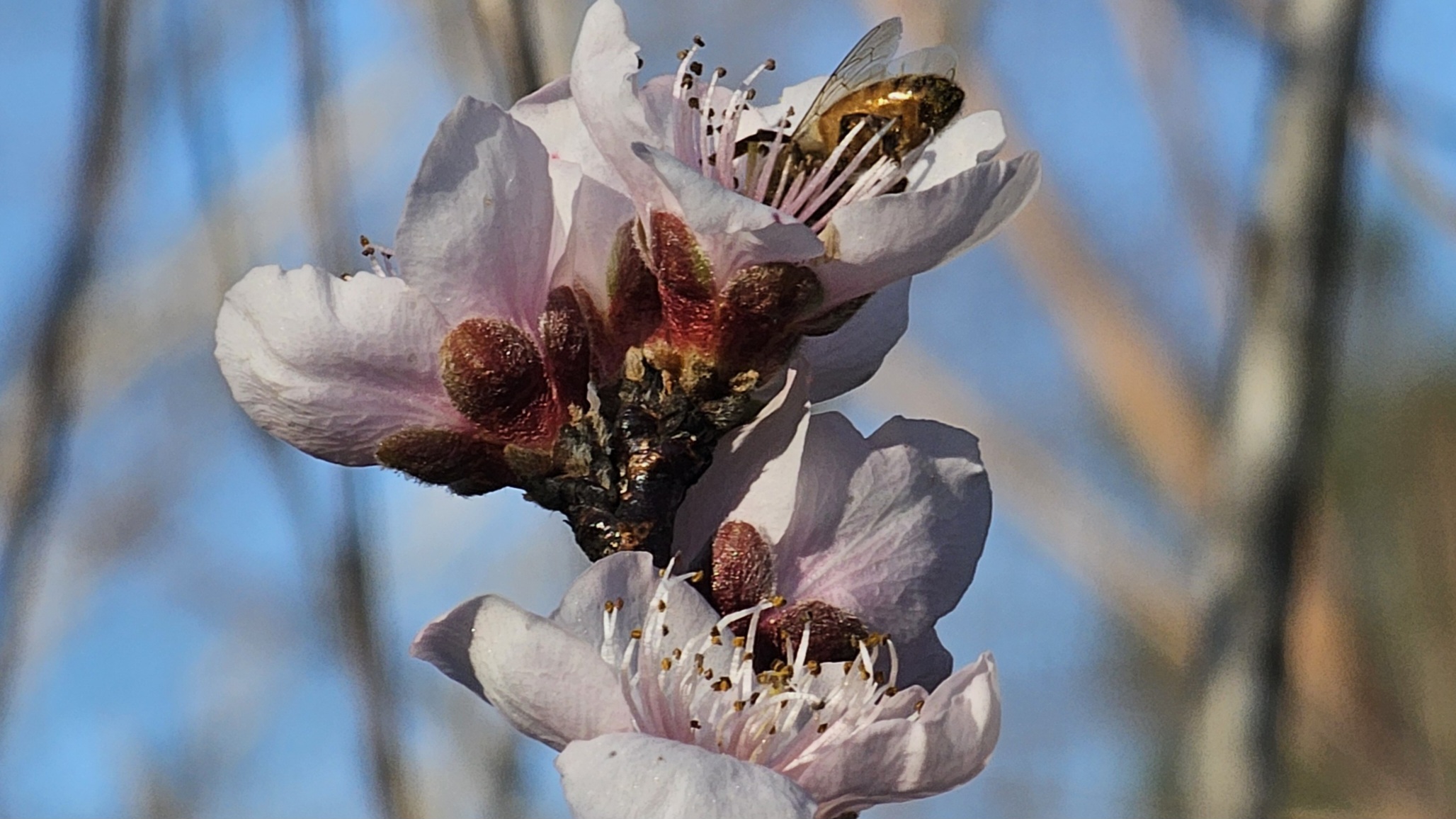
In addition to catching up with planting, we also danced a dance with the flowers of our nectarine tree. You see, we should have done our dormant spraying on our nectarine tree in December as it is the very first tree to put on buds in January. However, we did not. Now there was a race to get it done before the flowers open on the tree as the dormant spray is unsafe for pollinators such as our dear bees. We were late but the bees were definitely on time. So we worked hard to avoid the side of the tree that had flower buds opening. We hope that using these new techniques will make all the difference. You can see what we did here in this video.

A Month of Microgreens

Our microgreen CSA began early in February. It felt so good to be back in the routine of sowing, growing and harvesting the micros. Our little microgreen community is such an amazing group of folks. They encourage us each session with reassuring words and extravagant uses of their weekly delivery. So many beautiful creations! Knowing that they were crafted by goodies we grew makes us very proud! Although the microgreen side of the business is primarily handled by yours truly, I do say we because it is a group effort. I could not get through one week without the help of my family. Lifting trays, harvesting them, discarding to the chickens, cleaning – no I am no superwoman. I just have a super team and I am super thankful. And now I will stop being super corny.

This year we added a second level of excitement to our weekly newsletters for our microgreen subscribers. We started a private little group for them which was really designed to give members a behind the scenes experience of how their micros were grown and handled. It was fun. Here is a sample. It seemed to be well liked by those that watched the clips. Although we did not release one every week, it seems like it will be a permanent part of the microgreen sessions each season.

If you are local to the Dothan, Alabama area, you may be interested to know that our Summer Session is now accepting members. You may check out those details here.

A Month Of Renewals & Paperwork

There is much behind the workings of any business and a farm is no different. The beginning of the year there are growers permits, certifications, licensures, vendor applications, website & domain fees and much more that are all waiting to be addressed and/or paid. After dealing with a year of practically no income for the farm, this year was particularly stressful. I made due and tried to have a little fun doing so. This year I had the opportunity to converse with a few of the County Extension agents when applying for our 2025 Growers Permit. In our state, this is required to sell at farmers markets and other events. It is a minimum requirement and covers produce grown on your farm and value added products. This the one item that does not require payment. If you plan on selling items such as bouquets at your table at the farmers market, you will need to also apply for a peddlers license. If you plan on selling items prepared in your kitchen that is not inspected by the health department then you will also need a Cottage Food Law Certification. You must complete an approved food safety training course accredited by ANSI-National Accreditation Board (ANAB) to get this certification. This only needs to be done every 5 years thankfully. It has come back around for us and I am currently refreshing my mind on the information and processing the new updates so that I can take the test for our business before farmers market season resumes for us!

Speaking of Farmers Markets, we plan on attending Poplar Head Farmers Market on the following Saturdays of 2025:

  • May 24th
  • May 31st
  • June14th
  • July 5th
  • July 12th
  • July 26th

There may be more events that we will be attending as well. As those dates pan out will will add them to our Where Are We Now page. This year for the first time our little entrepreneur/daughter will be attending with her own table and set up. It is so rewarding seeing her use her God-given talents to enhance her life and build a career literally from the ground up. Her field is quiet unique. You can learn all about her talents and abilities on her YouTube channel here.

A Month Of Egg-citement

As the days begin to get progressively longer we welcomed back the steadier flow of butt nuggets! With the world in crisis over many things, eggs included, it was comforting to know our girls had not, in fact, forgot about us. The beautiful blues, greens, pinks and browns were once again back!

Egg costs are wild now days! If we were to actually charge to gain a profit from our egg sales then our costs would be ridiculous as well. We, however, only seek to balance out our feed costs with the our sales. To know with a certainty that this is working records must be kept and I have done very poorly with keeping track of our egg sales and production. So this month I decided to do better, especially after an little text discussion with a fellow farmer. Questions were asked that I had a difficult time answering due of poor record keeping. One more thing to work on for 2025! I was proud of myself for having downloaded an egg tracker sheet a while ago. At the very least I could ACTUALLY use it! I did! It was the end of the month when I started using it so March will be the better picture of how things are going. I’m a bit nervous to know the results. All I see is RED! Without seeing the numbers we already know that we will have to increase our egg cost for the 2025 fiscal year as all of the supplies we use to manage our flock has increased quite a bit. The records from the full month of March will help us narrow down how much exactly. Those costs will go into effect the month of May.

March is coming quicker than I have the ability to type or read. More interesting developments? Check back with us and see! Happy growing – from our family to yours!


Balsamic Onion Pickled Eggs

Let’s talk eggs! This time of year we find the girls are super productive. It’s like the last push as the daylight hours decrease. Just what to do with all those butt nuggets?

There are many ways of preserving eggs – dehydrating, freezing, freeze drying, water glassing. Today, though, we are exploring a more tasty option – pickling.

As you search the internet you’ll find all kinds of techniques for pickling and canning eggs for shelf stability. However, the National Center for Food Preservation doesn’t not have a shelf stable recipe. The only recipes they have are for refrigerator storage and it is not recommended to store pickled eggs at room temperature. We store our pickled eggs in the refrigerator. There they can last up to four months but they never do in our home! Let’s get started.

The Ingredients

  • 1 dozen small – medium eggs
  • Balsamic vinegar
  • Small red onion
  • Pickling salt
  • Cajun seasoning

The Prep

  • Jars – this is not a sterile project but of course you’ll want to clean your jars well.
  • Eggs – boil eggs to your preferences. We use mix a tablespoon of baking soda in the water to make peeling easier. IT WORKS! We put aside any that are damaged while peeling. We eat those right away.
  • Onion – chop or slice to your preference. Whatever you choose you’ll want to make sure the size is compact so as to not take up too much space in your jar.

Let’s Cook

Since this is a small batch we are doing things a tad differently than if we were doing a large batch. Since the brine we will be using would be hot we did warm our jars in the oven. We do this by placing just a tad bit of water on to a baking sheet and placing our jars on top into a 170° oven as it heats up. We leave them there until we are ready to use. You could just as well use your dishwasher or use hot water.

We layered our ingredients into the jars as tightly as possible. We started with the onion. After the onion, we packed those eggs in as tightly as we possibly could! Using small to medium eggs makes this much easier. Of additional benefit is that of using wide mouth jars.

After the jar is packed as tightly as possible we then poured in our balsamic vinegar to about 3/4 of the jar. Then we poured our apple cider vinegar in the remaining 1/4 of the jar. Be sure to make sure all the eggs are completely covered. At this point we did have to remove one of our eggs.

Now, using a strainer, (since these are being prepared just for our family, I used my hand) cover the jar securely and pour liquid mixture into a sauce pan. Add Pickling seasoning and Cajun seasoning (always to taste). Bring to a simmer. Pour brine over eggs. Secure with lid & ring. Allow to cool before placing in the refrigerator. If you want to seal the jar flip it upside down. The heat of the brine will seal the jar. Keep in mind it will still need to be stored int he refrigerator.

The hardest part of this recipe isn’t the cooking but THE WAITING! Wait a minimum of 2 weeks before cracking open your home pickled eggs! Trust us, it’s well worth the wait!

The Results

Our family was very adventurous in trying this recipe. I recorded video but haven’t convinced them to allow me to share it with you guys yet. It ended up being closer to 3 weeks when we tried these. Out of 5 only one family member didn’t like the flavor at all and another simply preferred a different flavor (Jalapeño Ginger) pickled eggs. The eggs do take on an ashen grey color on the outside but in the the brief time they remained in the fridge the Balsamic color didn’t reach the yolk although we think that would be quite an interesting looking egg! The Cajun seasoning flavor is there and it definitely enhanced the flavor however the heat was lost. If you are wanting a hot pickled egg we suggest perhaps adding actual peppers instead of just the seasoning.

We would love to hear from you if you try this recipe. Tag us! We would love to see your results!